Showing posts with label realistic fiction. Show all posts

Friday, July 18, 2014

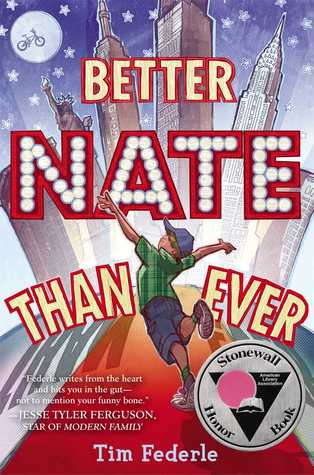
BETTER NATE THAN EVER, by Tim Federle

Quick Facts:
- 304 pages
- 2014 Odyssey Honor Book
- 2014 Lambda Literary Award Nominee for LGBT Children's/Young Adult
- this review is based on the audiobook
   + read by author Tim Federle
   + 5 hr, 55 min


There are books you read, both as a child and as an adult, that you enjoy because the characters inspire you in all the ways that they are different from you. They are braver and wittier and stronger, and you take from them lessons about how you can be all those things.

And then there are books you love because the characters are so like you, so awkwardly and painfully and hilariously real, that there are times it's as if the author jumped inside your head and used your thoughts.

In Nate Foster, the droll hero of Better Nate than Ever, author Tim Federle has created a character with whom it's nearly impossible not to empathize. The book chronicles Nate's attempt to crash an open audition in New York for a new Broadway show: E.T.: The Musical. The obstacles Nate encounters along the way, and his reactions to them, are just so perfectly authentic and treated with such humor, that you find yourself rooting for Nate even when you know something isn't going to go as he plans.

Which is not to say that Better Nate than Ever is a pure exercise in comedy. In a video for the New York Times "Culture" section, Federle discusses his awareness of the "gatekeepers" in children's literature. His goal when writing, he says, is to write something authentic that will entertain the adults as much as the children (he refers to it, appropriately, as the "Pixar Model".) Two major influences on his comedic style have been Ellen Degeneres and Bill Cosby, specifically for the way in which they addressed real topics with humor and without resorting to the "low hanging fruit" of "being mean or swearing."

I mention all of this because Better Nate than Ever deals with some very real issues. Nate is an exceptional child, and that makes him a flashing target for people's crueler impulses- even those of his own family. There are some really painful scenes, particularly involving Nate's brother and the way that Nate is treated in school. Federle never allows these scenes to become too heavy, primarily through Nate's humor about them, but it is clear nonetheless that the very humor that gets Nate through it is also a coping mechanism for survival.

Better Nate than Ever was nominated for the Lambda Literary Award, which recognizes books addressing the LGBT experience. However, it is not at all an LGBT issues book. Federle makes the wise and effective choice to place Nate as an individual at the center of his novel, so that everything else is secondary to Nate's own unique experience. Regarding his sexuality, Nate says only:

"My sexuality, by the way, is off-topic and unrelated. I am undecided. I am a freshman at the College of Sexuality and I have undecided my major, and frankly don't want to declare anything other than "Hey, jerks, I'm thirteen, leave me alone. Macaroni and cheese is still my favorite food- how would I know who I want to hook up with?"
- Better Nate than Ever

This refusal to label his thirteen-year old protagonist allows Federle to truly explore all the uncertainty, self-questioning, and confusion that comes with puberty in a way that is accessible for all young adults. Will young boys like Nate relate more closely to the character? Of course. But Nate's determination not to fit in to any box or allow himself to be labeled sends a much needed message to these kids (and to all kids): it's ok to be confused. It's ok to be unsure of yourself. You're still a kid, and you don't have to decide or announce anything to anyone.

The audiobook for Better Nate than Ever was a 2014 Odyssey Honor book, and I strongly recommend listening to it, even if you have already read the print version. Federle's reading of his novel brings Nate to life in all of his awkwardly hilarious glory and when it was over I felt strangely bereft of a friend.

Fortunately for me and for the world, Federle has already written a sequel to Better Nate than Ever: Five, Six, Seven, Nate!. I've already downloaded the audiobook to my phone.

Tuesday, July 15, 2014

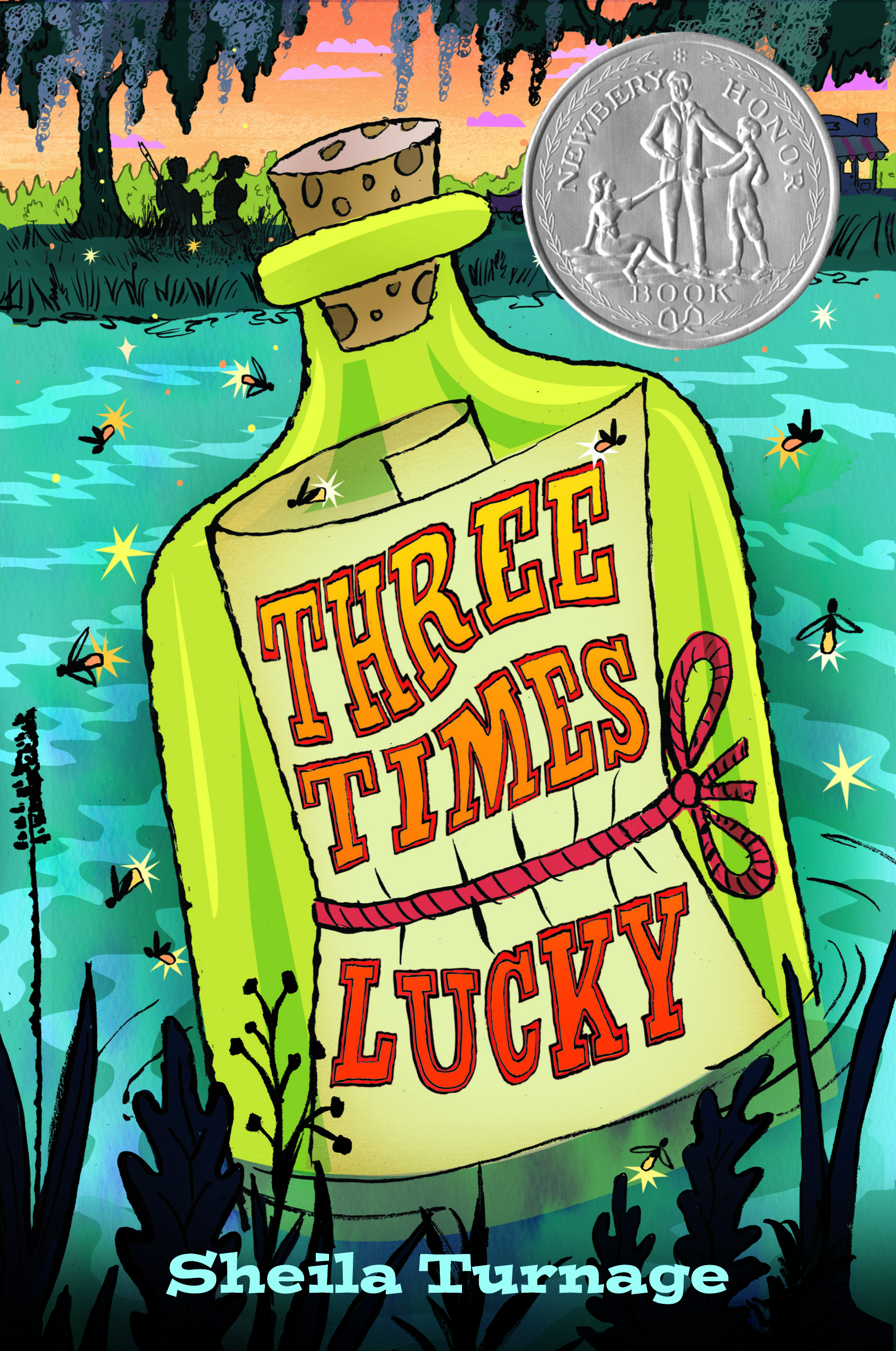
THREE TIMES LUCKY, by Sheila Turnage

Quick Facts:
- Newbery Honor Award Winner
- 256 pages
- Review based on audiobook:
  + read by Michal Friedman
  + 7 hrs, 57 min


". . . but dreams are shapeshifters. Get close and before you can lay a hand on them they change."

Before I say anything else about this book, I'm going to say this: do yourself a favor, and listen to the audiobook. Though I chose this format based on convenience (I've got a daily 2 hour commute), Michal Friedman's reading of Three Times Lucky brings heroine Moses ("Mo") LoBeau to life in a way I simply cannot imagine would have happened had I read the print version of the book. Don't get me wrong- author Sheila Turnage's writing is lively and engaging and does 95% of the work in terms of giving Mo an incredibly unique voice. However, it's a voice that begs to be read aloud, and Friedman does an absolutely brilliant job.

[As a disclaimer, quotes used in this review will be exact but will not include page numbers because, well, audiobooks do not have pages.]

Rising sixth-grader Mo LoBeau has a lot going for her: devoted adopted parents, a stalwart best friend, a community that supports her, and even an arch-enemy to keep things interesting. She's clever and funny and perceptive, and any reader who things that eleven year-olds "just don't talk like that!" hasn't ever met my youngest sister, Maggie.

The story kicks off with a local murder, which in Mo's small town of busybodies is much more than a newspaper headline. It's an event that causes waves throughout the entire town of Tupelo Landing. Distrustful of the newcomer detective that is put on the case, Mo and her best friend, Dale Earnhardt Johnson III, decide to form their own detective agency, the "Desperado Detectives" (Lost Pets Found for Free). They set off to solve the murder case on their own, and plenty of hijinks ensue.

There are reviewers who have been confused by the style of Three Times Lucky, pointing out that for a story revolving around a murder, there isn't much creepy or murder-esque about the book. It doesn't feel like a mystery. Instead, it's wacky and a bit off kilter, more concerned with character development than in the careful placement of clues that lead to a satisfying final reveal.

This is a valid point, as is the observation that there are many plot threads in Three Times Lucky that are left unresolved (and in some cases barely even addressed!) by the book's end. However, I'd argue this is more a function of the type of story Turnage is telling, rather than poor writing.

Hint: I don't believe she wasn't actually trying to write a traditional mystery.

I would classify Three Times Lucky as southern gothic literature for young readers. I'm dubbing it "Southern Gothic Lite". Goodreads defines southern gothic as that which "relies on supernatural, ironic, or unusual events to guide the plot." Furthermore, it uses said events "to explore social issues and reveal the cultural character of the American South." (Goodreads)

Let's consider the following plot drivers from Three Times Lucky:

Mo's Journey to Tupelo Landing: during a great flood eleven years prior to the events of the novel, Mo's mother supposedly placed an infant Mo on a floating sign, sending the baby adrift downstream to be discovered by strangers who name her Moses (get it?) and raise her as their own.

+ Mr. Jesse's Murder: the grumpy old man that no one particularly likes (or is particularly sad to see go, beyond the worry that his killing suggests there is a murderer on the prowl) turns up dead. In his own boat. A boat which Dale Earnhardt Johnson III had just returned to him.

+ The Colonel's Lack of Memory: the man who discovered an infant Mo floating downstream eleven years earlier cannot remember anything before that date.

I think it's fair to say that all qualify as unusual, with the first two qualifying as ironic. However, what is key is that these events are not simply used for comedic effect, but to introduce social issues and cultural character unique to the American South; in particular, the small-town, poor American South. Mo's journey to Tupelo Landing sets up Mo's very real struggle with what it means to be raised by people other than one's birth parents. Mr. Jesse's murder trigger's an exploration of small-town culture and interconnectedness. The Colonel's lack of memory allows the characters of the Colonel and Miss Lana to, for the majority of the novel, be defined wholly by their position within the community and position as town "newcomers". Turnage's larger-than-life characters, rather than simply reflecting southern stereotypes, are actually being used to reflect very real, and often hard, truths.

Perhaps the best example of this is Dale's older brother, Lavender. Lavender is a nineteen year-old race car driver, who walked out of his parents' house on his eighteenth birthday as a result of his father's drinking and violence. Mo adores Lavender, and he is indulgent of this adoration, and a protective and present big brother for Dale. In his availability to help Mo and Dale, Lavender can at times seem almost too conveniently mature for his age, unless one thinks about the southern social issue his character represents.

Lavender is the eldest in a poor, rural family with an abusive, alcoholic father. The sad truth is that children in these situations are forced to grow up at a very early age. They often shoulder an increasing emotional responsibility at home, and end up trapped by the very circumstances they dream of overcoming. Lavender's "career" as a race car driver and his subsequent abandonment of it isn't just a nod to the South's preoccupation with watching motorized vehicles drive in circles, it's a statement about the limited opportunities many of these kids face in the American South: being a driver made Lavender something of a local celebrity; it was a career that both Lavender and the reader could see taking him out of Tupelo Landing. And yet, by deciding build cars rather than drive them, Lavender essentially consigns himself to never leaving the small town, and family, into which he was born.

The tiny town that Lavender will likely never leave.


Now, Southern Gothic literature typically uses grotesque characters and focuses primarily on thoroughly unpleasant aspects of Southern culture. Turnage instead uses humorously over-the-top characters and focuses on those difficult realities of Southern culture with which a child can relate. This is appropriate for the upper elementary age she is targeting. Nevertheless, there is plenty of sharp, sad, adult humor in it as well, such as when eleven-year old Dale reveals that nineteen year-old Lavender told him he was "too pretty to do hard time" in prison. Children may simply laugh about a boy being described as "pretty" but adults will wince over children having the knowledge and experience to make that kind of statement.

Which is why I'm calling it Southern Gothic Lite. In tone, Three Times Lucky is closer to the David Altman comedy film "Cookie's Fortune" than it is the much darker work of Flannery O'Connor. And yet the image of an infant Mo floating down a Southern river, along with the biblical connection to the story of Moses, makes me suspect that Turnage is not unfamiliar with O'Connor's short story "The River".

Which is all to say that Three Times Lucky is a novel that must be taken on it's own terms. It is a comedic, dramatic, Southern Gothic mystery that is at once all and none of those things. Try to pin it down and you end up compromising (or, as I did, qualifying your label with "lite" as an easy out).

Friday, July 11, 2014

WONDER, by R.J. Palacio

Quick Facts:
- 320 pages
- New York Times Bestseller


Authors who depict characters with any sort of physical or mental health impairment inevitably are faced with a decision: whether or not to name the affliction. Though a seemingly trivial point, giving name to a character's illness can actually undermine the author's original message, if not handled carefully. Naming an illness, after all, requires that the author depict it authentically, and too often I've witnessed the poignancy of a character's struggle get lost in the medical research crammed in to ensure the condition is not misrepresented.

In Wonder, the reader is introduced to Auggie, a child who's physical deformities have kept him within the protective fold of his family since he was born. The story begins as Auggie enters his fifth grade year, attending for the first time a school with his peers. Though there are glimpses and hints into the specific nature of Auggie's condition throughout the book, the most illuminating line (both in terms of Auggie's physical appearance and his own perspective on it) is on the very first page of the book:

"My name is August, by the way. I won't describe what I look like. Whatever you're thinking, it's probably worse." - Wonder, page 3

R.J. Palacio never tells her reader specifically why August looks the way he does, and this allows the focus of the novel to rest not on the gratuitous medical details of his condition, but on the very real struggles (and joys!) he and his family encounter as a result of it. This choice does great service not only to the characters of the novel, but to the reader as well. Auggie can be anyone we've ever seen who's visibly different. For young readers in particular, still learning to navigate their social worlds with compassion, leaving Auggie's condition ambiguous makes it easily transferrable to situations they have encountered and will encounter in the future.

One of the things that Wonder does very well is highlight the way in which Auggie is not the only one affected by his differences. Though she begins the story from Auggie's perspective, Palacio propels the story from the point of view of several important people in Auggie's life, including his sister, his friends, and even his sister's boyfriend. Though Auggie remains always the central protagonist of the story, this insight in to the minds of the people surrounding him drives home the message that compassion and understanding are things we must choose. Told purely from Auggie's perspective, the novel would have been a moving account of a unique child's experience. With the accompanying perspectives, it becomes an exploration into the very real challenges of treating honestly and fairly someone so visibly different from the norm, and a call for all of us to look inside ourselves and to be better.

Aside from Auggie himself, two of the most compelling perspectives are those of Auggie's sister, Via, and his best friend, Jack. I say this because both of these sections give very legitimate exploration of the characters' less noble feelings. Take, for example, this section from Via's section:

"But as [Auggie] was kissing me with all his heart, all I could see was the drool coming down his chin. And suddenly there I was, like all those people who would stare or look away. 
Horrified. Sickened. Scared."
- Wonder, page 86

Via is a fiercely protective and loving older sister to Auggie, though she has recently become more distant. The quote above describes the first time she saw Auggie without the lens of protective and loving sibling, and it's pretty wrenching. Having already read Auggie's section, the reader knows how much he adores Via, and how this would hurt him. And yet, Via is a child, too. She's a child struggling with what it means to be kind and good and to take care of her little brother, and this quote is a very legitimate expression of that struggle. Too often, children are told to be compassionate of those different than themselves without any guidance about what that compassion really means. They are told to be better without any allowance that they are encountering these things for the first time and are going to have reactions of which they are less than proud. What Wonder does is tell kids: Hey, you're feelings are valid. But that doesn't mean they are right or fair. It's up to you to choose compassion over indifference, love over hate.

The same goes for Jack's section, in which he struggles with the very-real middle school dilemma of whether to be popular or kind. As adults it's easy to dismiss this struggle as a superficial one- but that's only because we've already come out the other side of it. The power of Wonder is the way in which it validates its characters' feelings while still asking them to step up and choose to be better.

Wonder is a beautiful, funny, and heartbreaking book that (unsurprisingly, given all I've described) had me in tears a fair bit of the time. Upon finishing it, I was reminded of a quote from another story that consistently makes me teary in its honest exploration of human emotions:

"I said you need to strive to be better than everyone else. I didn't say you needed to be better than everyone else. But you gotta try. That's what character is. It's in the trying."
- Friday Night Lights, "The Right Hand of the Father" (Season 5, Episode 3)