Tuesday, July 15, 2014

CODE NAME VERITY, by Elizabeth Wein

Quick Facts:
- Michael L. Printz Honor Book
- shortlisted for Carnegie Medal
- 368 pages
- review based on audiobook:
   + read by Morven Christie and Lucy Gaskell
   + 10 hr, 7 min


This book floored me.

No really.

It had me on the floor.

Code Name Verity, by Elizabeth Wein, is not a book for elementary students. It was recommended to me by a sixth grader (which is why I picked it up), but after reading it I would hesitate to recommend it for the average 11 year old. I think that thematically and in terms of the background knowledge required, it's better suited to eighth grade and up. That said, it is very likely that advanced middle school readers of all ages (like the sixth grader to suggested it to me) will be reading it, so it is certainly a book teachers should place on their to-read lists.

And also it's incredible. That's the main reason teachers and everyone else should read it.

Set in 1943, in Nazi-occupied France, Code Name Verity opens with a female, un-named prisoner of war being tortured for information by a commanding SS officer. The reader quickly learns three things about the narrator: she's Scottish, she's an Allied spy, and she is selling information to pay for her life. Wein, who has been praised for her historical accuracy, walks a careful line of accurately depicting the conditions of an Allied prisoner of war, without being sensational. Thus, although all of the Nazi hideousness we expect is present, it is not so explicitly drawn as to make the book too painfully uncomfortable to read, or developmentally inappropriate for upper middle and high school students.

This is a heavy place to begin. And yet, the narrator's voice comes through with such clarity, such humor, that it tempers the horror of her ordeal. One recurring point of frustration for our narrator is that her captors persist in calling her English:

“[I'm] . . . filthy, it goes without saying, but whatever else the hell I am, I AM NOT ENGLISH.”
- Code Name Verity

"I'M SCOTTISH!"
- Code Name Verity

This serves a duel purpose of developing the narrator as a character while also lightening the tone of the prose.

The conceit of Code Name Verity is that our narrator is writing for her captors a prose account of how she came to be in Nazi-occupied France, revealing secret Allied code and protocols as she goes. This is buying her niceties in her captivity. Like her own clothes returned so she doesn't freeze in her cell. Over the course of her account, she tells of her friendship with an female Allied taxi pilot named Maddie, and it becomes evident that the entire novel is ultimately a backdrop for the story of their friendship.

There is little more I can say about the plot or the structure of Code Name Verity without ruining a massive twist for future readers. That said, I will comment on the strikingly warm and authentic way in which Wein depicts a female friendship.

The Bechdel Test for evaluating film asks viewers to consider the following in movies they watch:

  1. Are there two or more female characters with names
  2. Do these characters talk to each other? 
  3. Do they talk about something other than men?

This is a perfectly acceptable test to apply to literature as well, particularly literature written for young adult women. Too often books aimed at young women define their female characters by their relationships with men (see: Gossip Girl, Twilight), or feature an otherwise almost exclusively-male cast (see: The Fault in Our Stars). For anyone upset with me for calling out John Green's tale of teenage love, consider the following:

  • There are three female characters with names: Hazel Grace, Mrs. Lancaster, and Lidewij.
  • They do talk to each other, but besides Hazel's medical condition, the only thing two things they talk about are Gus and Van Houten. Men.

Which is not to belittle The Fault in Our Stars. Only to say that when even some of the most celebrated and wide-read literature for young women barely passes the Bechdel Test, books like Code Name Verity stand out in stark and reassuring contrast.

The friendship our narrator (who is eventually named) and Maddie share is complex. They talk about everything from food to planes to affecting foreign accents and working for the British Royal Air Force (RAF). Though men enter their conversation at times, it is always as a side note, and the men most often discussed are the narrator's brothers in the context of her family. Both these women, as well as the others in this story (who shall at this time remain anonymous in the interests of keeping this post spoiler-free) are well-rounded, dynamic female characters in their own right, and seeing them in contact with other well-rounded, dynamic female characters is such a refreshing change.

The audiobook was beautifully read, and I recommend it to anyone who has limited time. However, after picking up a print copy of Code Name Verity, I realized that the book is really designed for (and rewards!) a traditional reader. There are many choices Wein makes with the text, print and structure of the traditionally bound book that give greater depth to the story.

As I've said, I think that Code Name Verity is a bit too mature a book for most upper elementary/lower middle school students. However, it is an incredibly beautiful, heartbreaking, and intellectually rewarding read for those ready for it.

And it will leave you on the floor. A little weepy, a little numb, a lot exhausted, but not regretting a single bit of the ride.

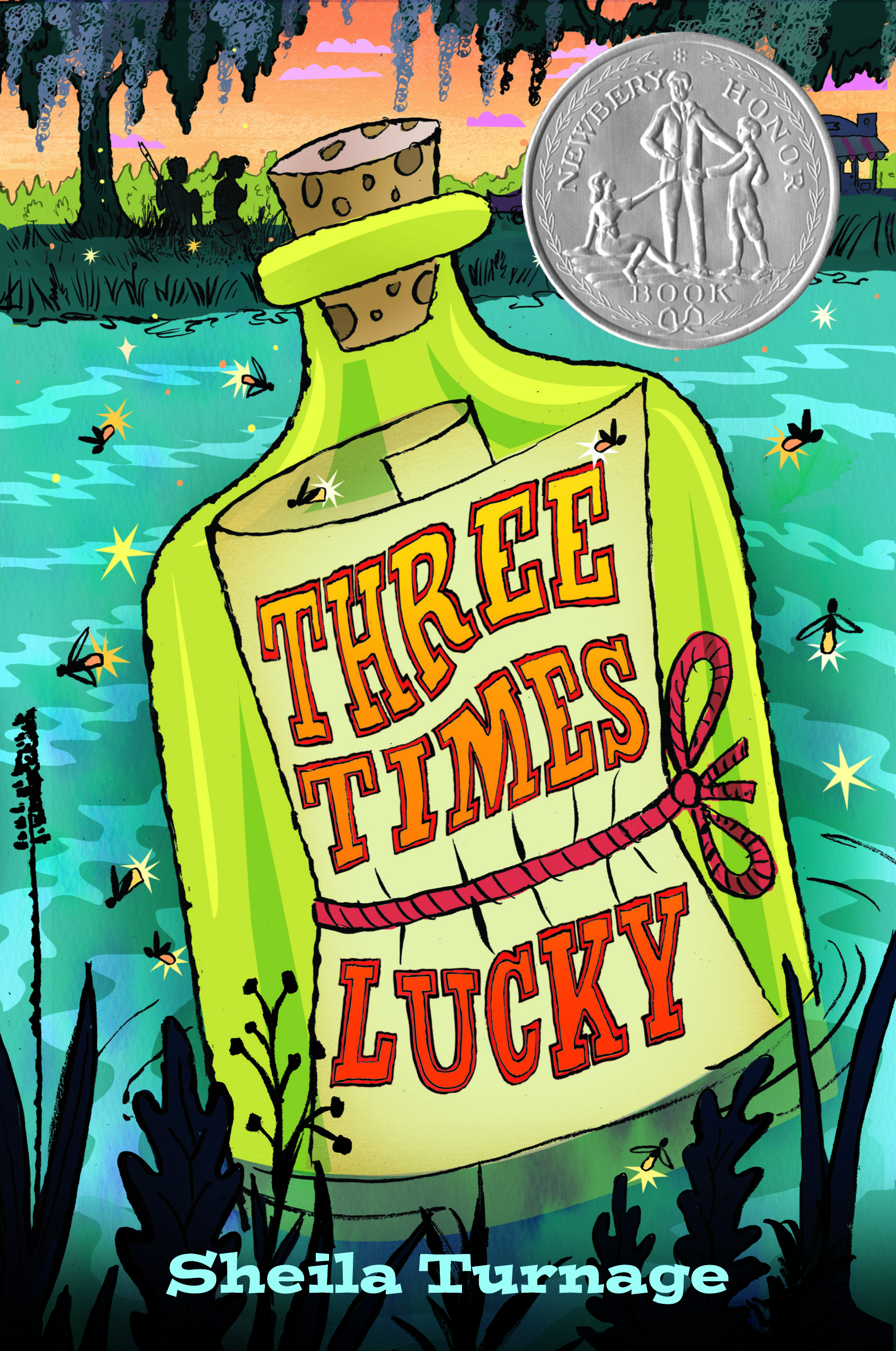
THREE TIMES LUCKY, by Sheila Turnage

Quick Facts:
- Newbery Honor Award Winner
- 256 pages
- Review based on audiobook:
  + read by Michal Friedman
  + 7 hrs, 57 min


". . . but dreams are shapeshifters. Get close and before you can lay a hand on them they change."

Before I say anything else about this book, I'm going to say this: do yourself a favor, and listen to the audiobook. Though I chose this format based on convenience (I've got a daily 2 hour commute), Michal Friedman's reading of Three Times Lucky brings heroine Moses ("Mo") LoBeau to life in a way I simply cannot imagine would have happened had I read the print version of the book. Don't get me wrong- author Sheila Turnage's writing is lively and engaging and does 95% of the work in terms of giving Mo an incredibly unique voice. However, it's a voice that begs to be read aloud, and Friedman does an absolutely brilliant job.

[As a disclaimer, quotes used in this review will be exact but will not include page numbers because, well, audiobooks do not have pages.]

Rising sixth-grader Mo LoBeau has a lot going for her: devoted adopted parents, a stalwart best friend, a community that supports her, and even an arch-enemy to keep things interesting. She's clever and funny and perceptive, and any reader who things that eleven year-olds "just don't talk like that!" hasn't ever met my youngest sister, Maggie.

The story kicks off with a local murder, which in Mo's small town of busybodies is much more than a newspaper headline. It's an event that causes waves throughout the entire town of Tupelo Landing. Distrustful of the newcomer detective that is put on the case, Mo and her best friend, Dale Earnhardt Johnson III, decide to form their own detective agency, the "Desperado Detectives" (Lost Pets Found for Free). They set off to solve the murder case on their own, and plenty of hijinks ensue.

There are reviewers who have been confused by the style of Three Times Lucky, pointing out that for a story revolving around a murder, there isn't much creepy or murder-esque about the book. It doesn't feel like a mystery. Instead, it's wacky and a bit off kilter, more concerned with character development than in the careful placement of clues that lead to a satisfying final reveal.

This is a valid point, as is the observation that there are many plot threads in Three Times Lucky that are left unresolved (and in some cases barely even addressed!) by the book's end. However, I'd argue this is more a function of the type of story Turnage is telling, rather than poor writing.

Hint: I don't believe she wasn't actually trying to write a traditional mystery.

I would classify Three Times Lucky as southern gothic literature for young readers. I'm dubbing it "Southern Gothic Lite". Goodreads defines southern gothic as that which "relies on supernatural, ironic, or unusual events to guide the plot." Furthermore, it uses said events "to explore social issues and reveal the cultural character of the American South." (Goodreads)

Let's consider the following plot drivers from Three Times Lucky:

Mo's Journey to Tupelo Landing: during a great flood eleven years prior to the events of the novel, Mo's mother supposedly placed an infant Mo on a floating sign, sending the baby adrift downstream to be discovered by strangers who name her Moses (get it?) and raise her as their own.

+ Mr. Jesse's Murder: the grumpy old man that no one particularly likes (or is particularly sad to see go, beyond the worry that his killing suggests there is a murderer on the prowl) turns up dead. In his own boat. A boat which Dale Earnhardt Johnson III had just returned to him.

+ The Colonel's Lack of Memory: the man who discovered an infant Mo floating downstream eleven years earlier cannot remember anything before that date.

I think it's fair to say that all qualify as unusual, with the first two qualifying as ironic. However, what is key is that these events are not simply used for comedic effect, but to introduce social issues and cultural character unique to the American South; in particular, the small-town, poor American South. Mo's journey to Tupelo Landing sets up Mo's very real struggle with what it means to be raised by people other than one's birth parents. Mr. Jesse's murder trigger's an exploration of small-town culture and interconnectedness. The Colonel's lack of memory allows the characters of the Colonel and Miss Lana to, for the majority of the novel, be defined wholly by their position within the community and position as town "newcomers". Turnage's larger-than-life characters, rather than simply reflecting southern stereotypes, are actually being used to reflect very real, and often hard, truths.

Perhaps the best example of this is Dale's older brother, Lavender. Lavender is a nineteen year-old race car driver, who walked out of his parents' house on his eighteenth birthday as a result of his father's drinking and violence. Mo adores Lavender, and he is indulgent of this adoration, and a protective and present big brother for Dale. In his availability to help Mo and Dale, Lavender can at times seem almost too conveniently mature for his age, unless one thinks about the southern social issue his character represents.

Lavender is the eldest in a poor, rural family with an abusive, alcoholic father. The sad truth is that children in these situations are forced to grow up at a very early age. They often shoulder an increasing emotional responsibility at home, and end up trapped by the very circumstances they dream of overcoming. Lavender's "career" as a race car driver and his subsequent abandonment of it isn't just a nod to the South's preoccupation with watching motorized vehicles drive in circles, it's a statement about the limited opportunities many of these kids face in the American South: being a driver made Lavender something of a local celebrity; it was a career that both Lavender and the reader could see taking him out of Tupelo Landing. And yet, by deciding build cars rather than drive them, Lavender essentially consigns himself to never leaving the small town, and family, into which he was born.

The tiny town that Lavender will likely never leave.


Now, Southern Gothic literature typically uses grotesque characters and focuses primarily on thoroughly unpleasant aspects of Southern culture. Turnage instead uses humorously over-the-top characters and focuses on those difficult realities of Southern culture with which a child can relate. This is appropriate for the upper elementary age she is targeting. Nevertheless, there is plenty of sharp, sad, adult humor in it as well, such as when eleven-year old Dale reveals that nineteen year-old Lavender told him he was "too pretty to do hard time" in prison. Children may simply laugh about a boy being described as "pretty" but adults will wince over children having the knowledge and experience to make that kind of statement.

Which is why I'm calling it Southern Gothic Lite. In tone, Three Times Lucky is closer to the David Altman comedy film "Cookie's Fortune" than it is the much darker work of Flannery O'Connor. And yet the image of an infant Mo floating down a Southern river, along with the biblical connection to the story of Moses, makes me suspect that Turnage is not unfamiliar with O'Connor's short story "The River".

Which is all to say that Three Times Lucky is a novel that must be taken on it's own terms. It is a comedic, dramatic, Southern Gothic mystery that is at once all and none of those things. Try to pin it down and you end up compromising (or, as I did, qualifying your label with "lite" as an easy out).

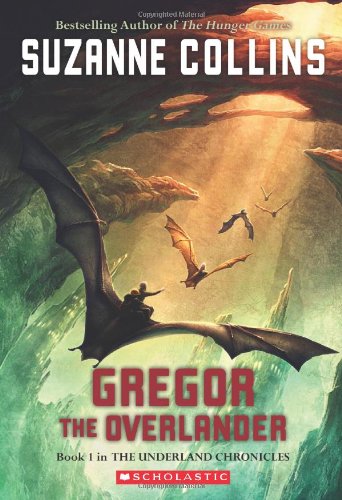
GREGOR THE OVERLANDER, by Suzanne Collins

Quick Facts:
- by the author of The Hunger Games
- 320 pages

I picked up this book for two reasons: 1) it was authored by Suzanne Collins (The Hunger Games) and 2) it was recommended to me by a 6th grade student with such enthusiasm that he tried to lend me his copies of the entire series at once. When a book gets a young reader that excited, it cannot be ignored.

Gregor the Overlander was Suzanne Collins' first novel, and it's an entirely different animal than her more well-known Hunger Games series. Gregor is an 11-year old boy living with his mother and sisters in a tiny New York apartment. They live on the brink of poverty, and Gregor has been acting as the man of the house since his father disappeared nearly three years before. When his toddler sister Boots falls, like Alice through the rabbit hole, into another world through an air-conditioning grate, Gregor follows her and the adventure begins.

The world where Gregor and Boots find themselves is known as the Underland, so called because it lies deep in the Earth, below the "normal" human realm at the Earth's surface. Thus, upon arrival in this world, Gregor and Boots are "Overlanders". The Underland is populated by creatures familiar and yet terrifyingly overgrown. Bats, cockroaches, rats, and spiders all control land in the Underland, but they are enormous compared to their Overland counterparts. The cockroaches are large enough for Boots to ride on their backs! Bats are large enough for humans to fly!

Fan art for Gregor the Overlander.
And in a move that plays with the familiar fantasy trend of humans riding on the backs of dragons, the humans living in Collins' Underworld bond with and ride Underland bats. This sort of familiar fantasy element presented in a novel way is part of what makes the Underland fascinatingly creepy instead of horrifically creepy.

One of Collins' greatest accomplishment in this novel is that despite remarkable world building and high-fantasy adventure plot lines, Gregor and Boots remain firmly the focus and heart of the story. Gregor is a character that wins the readers empathy and affection from the very first chapter. Despite being bitterly disappointed about having to stay home for the summer and take care of two-year old Boots instead of going going to camp, all he says to his mother is:

"That's okay, Mom. Camp's for kids, anyway." He'd shrugged to show that, at eleven, he was past caring about things like camp. But somehow that had made her look sadder."
- Gregor the Overlander, page 3

This sets up one of Gregor's most defining character traits: consciously placing the feelings of others above his own. He's not a saint. He's not a sweetly self-sacrificing martyr. Rather, he's a very typical eleven year-old boy with typical eleven year-old boy reactions who acknowledges and then actively suppresses his more selfish inclinations in favor of a greater good. Following the above quote, Gregor's mother offers to keep his nine year-old sister, Lizzie, at home with him and boots. Gregor refuses this, saying that his mother should let Lizzie go to camp, and noting only that:

"[Lizzie] probably would have burst into tears if Gregor hadn't refused the offer." Gregor the Overlander, page 3

Another appealing aspect of both Gregor and Boots is that they are in no way extraordinary. Unlike the heroes of similar stories in which a child leaves the normal world for a fantastical one and discovers that he or she is actually fantastical as well, Gregor and Boots remain endearingly normal. Their successes are a product of their own natures and choices, rather than a birthright or newly-discovered powers. For example, Boots' natural and uninhibited affection for most living things plays a key role in the novel's plot, but it is something that is characteristic of Boots from the very beginning:

"The smooth black bumps [Gregor] had taken for rocks were actually the backs of a dozen or so enormous cockroaches. They clustered around Boots eagerly, waving their antennas in the air and shuddering in delight.

Boots, who loved any kind of compliment, instinctively knew she was being admired. She stretched out her chubby arms to the giant insects. "I poop," she said graciously, and they gave an appreciative hiss."
- Gregor the Overlander, page 19

Boots' affection and kindness towards the cockroaches later sets an example for both Gregor and the other characters they encounter, emphasizing one of Collins' main themes of pursuing peace and mutual understanding over conflict and discord.

Perhaps the most remarkable thing about this novel, however, is it's pacing. Collins' moves briskly from scene to scene, without the reader every feeling as though she's moving too fast. Gregor and Boots, for example, are in in the Underland by the beginning of Chapter 2, meaning that all of our heroes' backstory is covered in a single, 13-page chapter. And yet, as Gregor and Boots are tumbling through space towards the Underland, the reader feels already as if he knows them. The reader has already a strong sense not only of who they are as characters, but of the impact their disappearance will have on their exhausted and overworked mother and their invalid grandmother. Thus, their journey has stakes even at it's outset, and the reader is invested in those stakes.

This pacing is consistent throughout Gregor the Overlander, and the casual reader may not process exactly how many messages and themes are packed into Collin's efficient, nimble writing. I've heard parents dismiss this novel as a "beach-read adventure", concerned that their child should be reading denser literature that "requires them to think".

I take issue with this. There is an enormous amount of thinking provoked by Gregor's journey, both in terms of moral decisions and writing style. The structure of the novel is impeccable and could easily be used to highlight for students the plot elements that create an effective and engaging story. Though The Hunger Games deals with more complex and abstract political themes, Gregor is by far the better crafted story, and I can see incredibly rich discussion in comparison of the two by fans of Collins' writing.

Gregor the Overlander is the first in a five-book series, The Underland Chronicles, and I have taken my 6th grade friend up on his offer to borrow them. Gregor's first adventure made such an impression on me, though, that I'm a little hesitant to begin reading them. The bar for the rest of the books has been set incredibly high.

Friday, July 11, 2014

WONDER, by R.J. Palacio

Quick Facts:
- 320 pages
- New York Times Bestseller


Authors who depict characters with any sort of physical or mental health impairment inevitably are faced with a decision: whether or not to name the affliction. Though a seemingly trivial point, giving name to a character's illness can actually undermine the author's original message, if not handled carefully. Naming an illness, after all, requires that the author depict it authentically, and too often I've witnessed the poignancy of a character's struggle get lost in the medical research crammed in to ensure the condition is not misrepresented.

In Wonder, the reader is introduced to Auggie, a child who's physical deformities have kept him within the protective fold of his family since he was born. The story begins as Auggie enters his fifth grade year, attending for the first time a school with his peers. Though there are glimpses and hints into the specific nature of Auggie's condition throughout the book, the most illuminating line (both in terms of Auggie's physical appearance and his own perspective on it) is on the very first page of the book:

"My name is August, by the way. I won't describe what I look like. Whatever you're thinking, it's probably worse." - Wonder, page 3

R.J. Palacio never tells her reader specifically why August looks the way he does, and this allows the focus of the novel to rest not on the gratuitous medical details of his condition, but on the very real struggles (and joys!) he and his family encounter as a result of it. This choice does great service not only to the characters of the novel, but to the reader as well. Auggie can be anyone we've ever seen who's visibly different. For young readers in particular, still learning to navigate their social worlds with compassion, leaving Auggie's condition ambiguous makes it easily transferrable to situations they have encountered and will encounter in the future.

One of the things that Wonder does very well is highlight the way in which Auggie is not the only one affected by his differences. Though she begins the story from Auggie's perspective, Palacio propels the story from the point of view of several important people in Auggie's life, including his sister, his friends, and even his sister's boyfriend. Though Auggie remains always the central protagonist of the story, this insight in to the minds of the people surrounding him drives home the message that compassion and understanding are things we must choose. Told purely from Auggie's perspective, the novel would have been a moving account of a unique child's experience. With the accompanying perspectives, it becomes an exploration into the very real challenges of treating honestly and fairly someone so visibly different from the norm, and a call for all of us to look inside ourselves and to be better.

Aside from Auggie himself, two of the most compelling perspectives are those of Auggie's sister, Via, and his best friend, Jack. I say this because both of these sections give very legitimate exploration of the characters' less noble feelings. Take, for example, this section from Via's section:

"But as [Auggie] was kissing me with all his heart, all I could see was the drool coming down his chin. And suddenly there I was, like all those people who would stare or look away. 
Horrified. Sickened. Scared."
- Wonder, page 86

Via is a fiercely protective and loving older sister to Auggie, though she has recently become more distant. The quote above describes the first time she saw Auggie without the lens of protective and loving sibling, and it's pretty wrenching. Having already read Auggie's section, the reader knows how much he adores Via, and how this would hurt him. And yet, Via is a child, too. She's a child struggling with what it means to be kind and good and to take care of her little brother, and this quote is a very legitimate expression of that struggle. Too often, children are told to be compassionate of those different than themselves without any guidance about what that compassion really means. They are told to be better without any allowance that they are encountering these things for the first time and are going to have reactions of which they are less than proud. What Wonder does is tell kids: Hey, you're feelings are valid. But that doesn't mean they are right or fair. It's up to you to choose compassion over indifference, love over hate.

The same goes for Jack's section, in which he struggles with the very-real middle school dilemma of whether to be popular or kind. As adults it's easy to dismiss this struggle as a superficial one- but that's only because we've already come out the other side of it. The power of Wonder is the way in which it validates its characters' feelings while still asking them to step up and choose to be better.

Wonder is a beautiful, funny, and heartbreaking book that (unsurprisingly, given all I've described) had me in tears a fair bit of the time. Upon finishing it, I was reminded of a quote from another story that consistently makes me teary in its honest exploration of human emotions:

"I said you need to strive to be better than everyone else. I didn't say you needed to be better than everyone else. But you gotta try. That's what character is. It's in the trying."
- Friday Night Lights, "The Right Hand of the Father" (Season 5, Episode 3)

Tuesday, July 8, 2014

THE ROUGH-FACED GIRL, by Rafe Martin

Quick Facts:
- Illustrated by David Shannon
- 32 pages


Native American cultures are among those most frequently misrepresented in popular culture and literature, particularly in that targeted to young audiences. Too often, children's understanding of Native Americans is limited to the European-crafted tale of Thanksgiving and the high adventure and high stereotyping of cowboy/Indian tales.

The Rough Faced Girl, by Rafe Martin, is unique in its respectful and authentic retelling of an Algonquin "Cinderella" story. Rather than using the familiar story structure to incorporate western European elements into the story, Martin stays true to the tale's Native American perspective- even when that leads to narrative choices that have the potential to confuse conventional western-European audiences.

One of the most fascinating aspects of The Rough Faced Girl is the "prince" figure, here known as the Invisible Being. In most traditional versions of Cinderella, the prince is little more than a symbol of power, a reward that Cinderella receives for being pious/generous/gracious/etc. The Invisible Being of this tale, however, is more nuanced. He lives with his sister, who speaks with all the women who wish to marry her brother. Her questions suggest something very interesting about the Invisible Being: that the only woman who will be able to see him is the one who knows already what he looks like.

This seems contradictory, for how could any woman know what he looks like if he is invisible? The answer, of course, is revealed during the titular Rough Faced Girl's conversation with the Invisible Being's sister. Though I will not spoil it, I will say that it is grounded in Native American respect for and understanding of humans' relationship with nature, and is thus in keeping with the cultural heritage of this particular "Cinderella" tale.

David Shannon's illustrations further reinforce both the cultural background of the story. Shannon uses muted, largely earth-tone colors suggestive of Native American art. The brightest illustrations come towards the end of the book, when he is depicting scenes of nature that have a distinctly spiritual, otherworldly cast to them. Reserving his brighter colors for these scenes emphasizes their importance to both the story and to the culture that produced it.


In terms of characterization, the Rough Faced Girl is at once a familiar and a progressive "Cinderella" figure. Like many of the heroines that populate similar stories, the Rough Faced Girl is kind, gentle, and virtuous. Her identification of the Invisible Being also suggests that she is more spiritually aware than the other women vying for his hand. However, unlike many of her counterparts, the Rough Faced Girl is the primary instrument of her own fate. There is no fairy godmother, or magic bird, or helpful crocodile that shows up with a means of her escape. Rather, after being told by her father that he has nothing left to give her, the Rough Faced Girl creates her own garments and goes on her own power to seek the Invisible Being and his sister.

Ultimately, it is the Rough Faced Girl's own understanding of the Invisible Being that wins her his hand, rather than her beauty or an intriguing glass slipper.


GLASS SLIPPER, GOLD SANDAL: A Worldwide Cinderella, by Paul Fleischman

Quick Facts:
- Illustrated by Julie Paschkis
- 28 pages

Glass Slipper, Gold Sandal is a cleverly conceived and gorgeously realized patchwork of various elements found in the Cinderella stories told all over the world. While it is not the most satisfying stand-alone Cinderella tale I've read, it does an excellent job bringing diverse versions of the tale together in to a coherent whole that, ultimately, leaves the reader wanting to know more about the stories from which each individual piece was sourced.

One of the greatest challenges of this book comes from its aim to not only bring together many versions of the same story but to simultaneously highlight the culture of each contribution. After all, flagging the text of each section with its country of origin (Russia! Iran! India!) would be distracting and interrupt the flow of the story. It would detract from that message that despite the variances, the story remains structurally same.

Author Paul Fleischman and illustrator Julie Paschkis meet this challenge through coordination of the text layout and the accompanying illustrations.


Notice how Fleischman separated the text by its country of origin, and then how Paschkis framed each chunk of text with artwork representative of that country. Though the country of origin for each section is clearly identified, it is identified in the illustration and done in the same colors as the illustration. The effect of this is to allow the text and primary illustrations (such as the Cinderella in a kimono) to draw the reader's initial attention and focus. Thus, the story maintains its flow as a single, cohesive tale. However, the segmenting emphasizes the way in which different aspects of the tale were drawn from different sources, with those sources visually and textually represented for those who care to examine closer the story's diversity.

Paschkis' folk-art style also contributes to the cohesiveness of the story as a whole. Though contributing countries are made distinct both with color and with the presentation of people and setting within each scene (see the distinctly Chinese style of the fish in the red section, in comparison to the purple Indonesian crocodile), they are also bound by the folk art style. This suggests, again, that though each culture has its own way of telling the story of Cinderella, they are all ultimately telling the same story.

One aspect of this book I found particularly interesting was the decision to bookend the Cinderella story with images of a woman reading Glass Slipper, Gold Sandal to a little girl. Narratively, this underscores the oral tradition of the story across cultures, and the way it has been passed down through generations. However, Paschkis' decision to depict the woman and girl as different ethnicities is clearly a conscious one. I say woman and girl, rather than mother and daughter, because I think the relationship between these two figures is deliberately ambiguous.


The most obvious interpretation is, of course, that it is a mother reading to her daughter. In this context, the image reflects a multi-cultural family. However, I think it is more powerful to consider the woman as simply representative of an older generation, and the girl representative of the younger one. They are of different ethnicities because, actually, their ethnicity doesn't matter any more than does their relationship. The message of the book is that these tales have been passed for hundreds of years from one generation of another, through the sharing of stories. This image, as well as the similar one at the book's opening, reflects this.


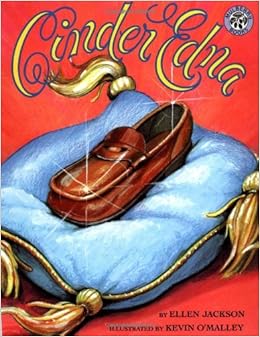
CINDER EDNA, by Ellen Jackson

Quick Facts:
- Illustrated by Kevin O'Malley
- 29 pages

There is nothing subtle about the moral of Cinder Edna, which retells the familiar story of Cinderella in a near-modern setting with two impoverished protagonists instead of just one. In the story, the tale of Cinder Ella is told parallel to that of her neighbor's, Cinder Edna, who has a similar home life to Cinder Ella but deals with it in very different ways.

I'm not a huge fan of books with as overt a feminist message (or really any political message) as Cinder Edna presents. I find that in such cases the story often is sacrificed for the message, and (for me) that takes a great deal out of the magic of storytelling.

Cinder Edna has some inspired moments. However, all of these occur the story of Cinder Edna herself; the tone of Cinder Ella's story, as depicted here, is full of sarcastic comments and asides that verge on disparaging. In a story about embracing who you are, this really rubbed me the wrong way.

To demonstrate what I mean, take the following lines from the Cinder Ella storyline:

"Meanwhile, Cinder Ella's big, bright eyes filled with tears. "But, Fairy Godmother, how will I get to the ball?"

The fairy godmother was surprised that her goddaughter couldn't seem to figure anything out for herself.
- Cinder Edna, page 9

To contrast this, and to underscore Cinder Ella's utter incompetence and dependence on others, Cinder Edna is shown taking the city bus.

Now I love the idea of a Cinderella character taking control of her fate, and Cinder Edna's bus ride (during which she is shown reading to children) is a fantastic spin on the story. In fact, all of Cinder Edna's exploits are fantastic spins on the classic tale. She's cheerful and hardworking! She plays the accordion! She's not the prettiest girl around, but what does that matter anyway? She's "strong and spunky and knew some good jokes"! (Cinder Edna, page 6)

Cinder Edna's prince is similarly delightful. He's short and bespectacled and runs a recycling plant and home for orphaned kittens. His name is Rupert. Naturally, he and Cinder Edna share many interests in common, get along famously, and are set up for one of the most believable "happily ever afters" to be found in a fairy tale. The colors used to tell the story of Cinder Edna and Rupert are bright and bold and cheerful, matching the characters perfectly.


However, I find there is much to be desired in the message sent by both the writing and the illustrations of Cinder Ella's story. As the quote above demonstrates, Ellen Jackson apparently felt that in order to tell the story of spunky Cinder Edna, she needed to contrast it with a more traditional telling. So she includes Cinder Ella, who is consistently shown as whiny, incompetent, lazy, and superficial. Cinder Ella is beautiful, and that is the only thing that gets her anywhere. This, as well as the other listed traits, is captured perfectly in the following illustration (which is a small section of the larger illustration of Cinder Ella's wedding):


She's not even looking at her groom and is in the process of putting on lipstick! Furthermore, the text of Cinder Edna's story constantly takes jabs at Cinder Ella:

"Edna had tried sitting in the cinders a few times. But it seemed like a silly way to spend time."
- Cinder Edna, page 5

Additionally, consider the illustrations that accompany the text about how the two girls made it to the ball:


Cinder Ella is dolled up like a southern beauty pageant contestant, either tripping over or gasping in horror at the mice surrounding her. Either way, her fairy godmother in the background is thoroughly unamused. Cinder Edna, however, is shown dressed simply, and smiling as she reads a book called "Woofers and Tweeters" to a black child on the city bus.

Look! these pictures say. Cinder Ella is whiny and stupid and annoying and stuck in conventional gender roles, while Cinder Edna is fun and happy and capable! Cinder Ella squeals at a few mice, but Cinder Edna has no problem riding the public bus and striking up conversations with people of diverse backgrounds. Also she reads.

Again, my issue is not with Cinder Edna's story, but with the way in which the book mocks Cinder Ella in contrast. I'm sure the author intended the book's overall message to about women embracing their own abilities and staying true to themselves. However, the message that comes across is that women should embrace their own abilities and stay true to themselves as long as they are Cinder Edna. If you are pretty, or like pretty things, or aren't sure how to handle a situation, or ask for help- well, then you're pathetic and we are going to mock you. Oh, and you're destined for marriage with a vain idiot who won't actually care about you.

This is not a productive message to send our girls. Though I'm all for more Cinder Edna characters, who take care of themselves and are fine with taking a city bus to a ball, I do not think it's necessary or helpful to throw the Cinder Ellas of the world under that same bus in the process.