Showing posts with label collection. Show all posts

Wednesday, July 23, 2014

NURSERY TALES AROUND THE WORLD, by Judy Sierra

Quick Facts:
- collection of diverse folk stories
- 128 pages
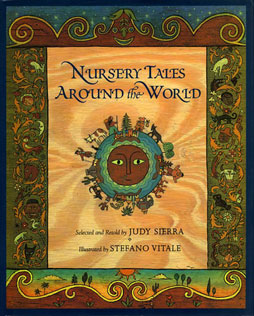

Nursery Tales Around the World, selected and retold by Judy Sierra, is a collection of traditionally oral folktales from around the world, organized by theme and/or storyline. Sierra explains in the introduction that her focus when making the selections for this collection was on stories strong in rhythm, rhyme and/or repetition, as they are "tailored to children's developing memory and imagination and to their unique way of viewing the world." (Nursery Tales Around the World, xi)

Thus, by design, these are stories that reward those who read them aloud. One section particularly demonstrative of this is the "Runaway Cookies" section. In the Norwegian folktale "The Pancake", the following exchange takes place as children watch their mother making a pancake:

"Oh, give me a bit of pancake, Mother dear," said one of the children.
"Oh, darling Mother," said the second child.
"Oh, darling, good Mother," said the third.
"Oh, darling, good, nice Mother," said the fourth.
"Oh, darling, pretty, good, nice Mother," said the fifth.
"Oh, darling, pretty, good, nice, clever Mother," said the sixth.
"Oh, darling, pretty, good, nice, clever, sweet Mother," said the seventh."
- Nursery Tales Around the World, page 11

Not only does this passage play with rhythm and repetition, but each child's addition of a new adjective reflects a child's growing awareness of language. Children discovering the power of adjectives will likely find this passage quite funny, and identify with the speakers' implication that they will be chosen for the prize if they choose the best adjective to contribute. Sierra introduces each section with a short author's note about the stories included. In the note accompanying the "Chain Tales" section, she specifically cautions parents to resist the temptation to skip the repetition in the stories, as "young children love it, and will soon begin repeating the chains along with you." (Nursery Tales Around the World, page 57)

I was concerned, at first, that having traditional stories for each of the five identified story types would ultimately mean that the book contained only five truly distinct stories, that the story type would be more distinctive than the tales themselves. Though Sierra groups stories with a clear thematic link, her selections are distinct enough to stand out from the others in their grouping. For example, within the "Incredible Appetites" section, she includes first what is essentially a poem ("I Know an Old Lady Who Swallowed a Fly"), then a tale that revolves around a father and a son ("The Boy Who Tried to Fool His Father"), and finally a story about a cat so arrogant he can't stop eating ("The Cat and the Parrot"). Each of these involves extraordinary feats of consumption that grow more incredible as the tale goes on, but each is also very distinct from the others, keeping the reader from feeling as though they are reading the same story over and over. For young readers, this is likely a strength of the book, as it helps them identify story patterns.

Sierra identifies at the start of each story its country of origin, and Stefano Vitale's illustrations help give evoke the culture of each contributing culture while still giving the book as a whole a "folk tradition" feel.  Compare, for example, the following illustrations that appear at the start of "The Boy Who Tried to Fool his Father" (Zaire) and "The Cat and the Parrot" (India):

"The Cat and the Parrot"
"The Boy Who Tried to Fool His Father"


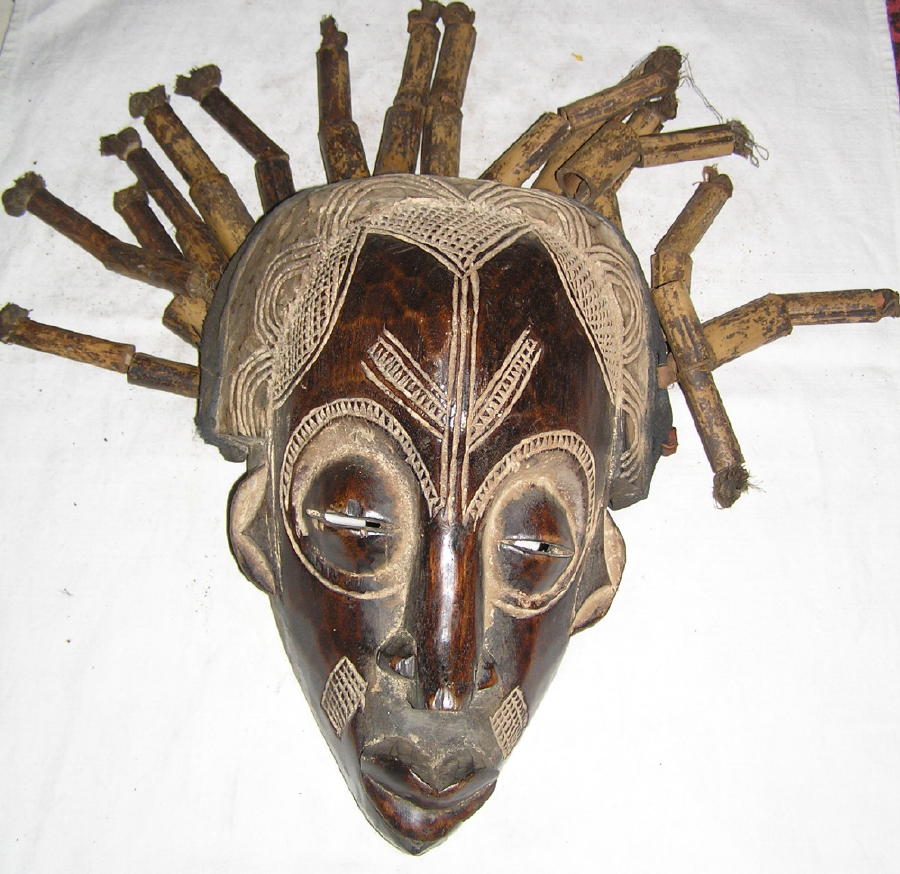
"The Boy Who Tried to Fool His Father" is from Zaire, Africa, and Vitale's use of muted colors and a wall-carving style evokes art from Zaire (see left image below). Meanwhile, the rich red, greens and purples of "The Cat and the Parrot" suggest traditional Indian artwork:
Painting of Hindu deity Ganesh.

Carved mask from Zaire, Africa


Sierra includes both a bibliography and a note on her sources for and retelling of each tale. Where she chose to retell parts of a story, she notes that her choices in retelling were primarily prompted by poor transcriptions of oral tellings or "awkward" rewrites of the tale that detracted from the storytelling.

Nursery Tales Around the World is a well-researched, well-written, and well-organized collection of both familiar and new folk tales that will entertain both children and adults.

But do yourself (and Judy Sierra!) a favor: read them aloud. Keep their oral tradition alive.

DARK EMPEROR & OTHER POEMS OF THE NIGHT, by Joyce Sidman

Quick Facts:
- illustrated by Rick Allen
- poetry
- collection
- Newbery Honor Book

"Dark Emperor & Other Poems of the Night" is a collection of poems linked by the theme of what happens in nature after the sun goes down. The poems are organized in a natural progression, beginning (appropriately) with "Welcome to the Night" and ending with "Moon's Lament", which reflects the moons feelings about the coming dawn.

Despite their strong thematic link, each poem is distinct and self-contained enough to be enjoyed on its own. The effect of this is that the poems complement one another, rather than relying on one another. You can enjoy "Night-Spider's Advice", for example, completely on it's own. But you see it in a different light once you've read "Cricket Speaks", simply for the way in which you can imagine these two perspectives might be at sometimes fatal odds.

One of the most interesting choices author Joyce Sidman makes is to include an informational blurb with each poem, printed on the page opposite the poem. This information actually serves to support and deepen the reader's understanding of the poem, while also providing a teaching moment about nature. For example, on page 8 the poem "Snail at Moonrise" refers to a snail as "shell-maker". The informational blurb on page 9 then elaborates on this, telling the reader that young snails produce a special material that helps them add layers to their shells as they grow. By focusing the informational blurb to what is relevant to the poem, Sidman not only provides support for understanding her poems, but encourages the reader to be active in their reading of her poetry.

"Dark Emperor & Other Poems of the Night" contains many different poetry styles, each poem playing with rhyme, rhythm and sounds in different ways. For example, consider this portion of one of my favorite poems, "Ballad of the Wandering Eft":

"Come all you young efts,
so brave and so bold,
and don the bright colors
of scarlet and gold.

Step out from your puddles
to breathe the sweet air
and wander the woodlands
with hardly a care.

     For it's wild and it's windy
    way out in the woods,
    where the moss grows like candy
    and the hunting is good,
    where the rain falls from heaven
       and mud's underfoot
    It's wild and it's windy
    way out in the woods.
- "Dark Emperor & Other Poems of the Night", page 24

As is typical with ballads, it has a repeating verse (the italicized one), and uses consistent syllable patterns and rhyme to create a rhythmic flow to the poem. The poem is structured symmetrically: verse, verse, chorus, verse, verse, chorus.

Now consider "Dark Emperor". Along with having no rhyming pattern or syllabic consistency, "Dark Emperor" plays with words in a wholly different way:


The poem looks like an owl! The final verse, which references a "tiny hiccup" when considering the owl's predatory prowess looks (in contrast and placement) like a small animal about to become the owl's prey. This diversity in poetic style and structure makes "Dark Emperor & Other Poems of the Night" an excellent introduction for students to the variety of forms poetry assumes.

Finally, Rick Allen's woodcut illustrations are appropriate and support the poems not only by highlighting both the grit and beauty of nature, but by using the play of darkness against light in a way suggestive of the moon glinting through leaves:


These images support the sense that the poems give the reader of glimpsing into a familiar and yet unknown world, the effect of the woodcut style and the play with light rendering familiar images more complex then we are used to seeing them.

Friday, July 18, 2014

GOOD BOOKS, GOOD TIMES!, compiled by Lee Bennett Hopkins

Quick Facts:
- illustrated by Harvey Stevenson
- poetry collection
- 32 pages
- contributing poets include: Karla Kuskin, Jack Prelutsky, Arnold Lobel, and more


Good Books, Good Times! is an anthology of poems collected specifically for their focus on books and reading. There are fourteen poems in all, and each poem is given a full, two-page spread for both the poem and its accompanying illustration. The effect of this is that the reader is truly able to focus on and get lost in each poem, without any distraction from the accompanying page. I love Shel Silverstein's Where the Sidewalk Ends, but I remember as a child rushing through certain poems because the illustration on the opposite page made its poem look so much more interesting. Good Books, Good Times! therefore does an effective job of allowing each poem to really be appreciated on its own.

One thing that impressed me about this anthology was the variety of poetry styles that are represented. Despite having only fourteen poems, the collection includes everything from free verse to familiar rhyming patterns to poems with only two words in each line. This makes it a wonderful introduction to poetry for children who may have the idea that poetry has to rhyme, or is always bound by specific syllable patterns. I love imagining students' faces after having this poem read to them:

AN HISTORIC MOMENT
by William J. Harris

The man said,
after inventing poetry,
"WOW!"
and did a full somersault.
- Good Books, Good Times!

Harvey Stevenson's illustrations to a wonderful job reflecting the poems they accompany in ways that often bring even more humor to the poem, and can help new readers of poetry begin to understand how you read and take meaning from poems. For example, look at the illustration that accompanies "An Historic Moment" from above:


There are many ways this could have been illustrated that would have shown the events of the poem. For example, Stevenson could have chose to divide the story in to separate frames, telling each moment (inventing poetry, WOW!, and the somersault) individually. However, that would not have been a true reflection of the poetry style Harris uses here. The poem is short, abrubt, unexpected. The entire poem, is in effect, a single moment- the moment that the man invented poetry. Thus, Stevenson's choice to show only that moment of movement into a somersault is completely appropriate. Too, it's funnier!

Which raises another point about the poems in this book- they are fun to read. Below is the first verse one of my favorites, by Isabel Joshlin Glaser and titled "What If . . .":

What if . . .
   You opened a book
   About dinosaurs
And one stumbled out
And another and another
   And more and more pour
Until the whole place
Is bumbling and rumbling
And groaning and moaning
   And snoring and roaring
And dinosauring?

Not only does it address a very real, rather wishful thought many of us have about our books (even in our twenties!) but it's fun to read, particularly aloud. "Bumbling and rumbling" and "snoring and roaring and dinosauring" are just silly and fun to say. This is important because the theme of the collection is the joy of reading. If it were full of poems that discussed the joy of reading without bringing any joy to their own reading, the collection would have fallen a bit flat.

Good Books, Good Times! is an excellent introduction to several different types of poetry, and to a variety of poets who whose work is truly fun to read. The illustrations lend humor while also providing support for interpretation of each poem. Overall, it is an excellent read-aloud choice for young readers of all ages, but is a particularly good starting point for independent readers beginning to grasp the concept of rhythm and rhyme.