Showing posts with label poetry. Show all posts

Saturday, July 26, 2014

GUACAMOLE: UN POEMA PARA COCINAR, by Jorge Argueta

Quick Facts:
- bilingual with full text in both English and Spanish
- a "cooking" poem
- 32 pages
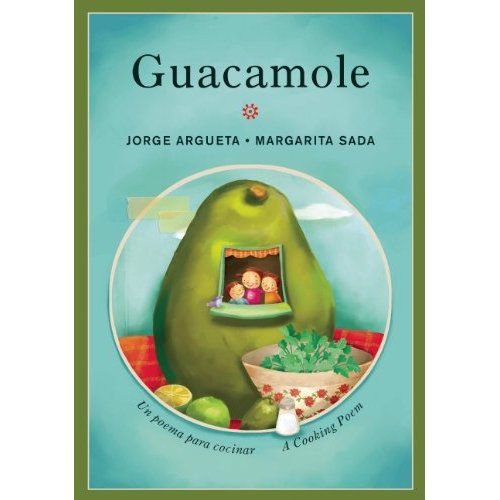

“Guacamole” is a recipe poem written by Salvadoran poet Jorge Argueta. It is the third book in Argueta’s bilingual cooking poem series. His first two books, titled “Sopa de frijoles / Bean Soup”, and “Arroz con leche / Rice Pudding”, are structured similarly to “Guacamole. In all three, the poems’ verses span several pages, provide full text in both Spanish and English, and are accompanied by illustrations that enhance the text.

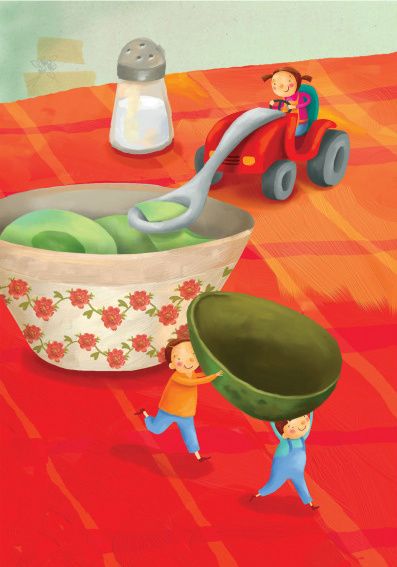
“Guacamole” is short, takes about seven to ten minutes to read aloud, and Mexican artist Margarita Sada’s accompanying oil-paint illustrations are as colorful and vibrant as the guacamole Argueta describes making. The illustrations are authentic in their depiction of the ingredients and materials needed throughout the poem, but use a much more round, cartoon feel when depicting everything else. By giving the family depicted a generic, light olive skin tone and brown hair, illustrator Sada remains true to the Spanish heritage that traditionally makes guacamole, while still making the book accessible to a wide variety of children reading and looking to see themselves in the illustrations:


One of the things I love about this book is that the title is the same in English and in Spanish: Guacamole. Thus, despite the poem being presented in two different languages, the finished product is one with which native speakers of either language can relate. Cooking is such a social part of families and culture that the idea of making food to bring one’s family together is one with which nearly all readers can identify. One of my favorite lines in "Guacamole" is when Argueta encourages this social aspect of cooking and tells the reader/cook to sing and dance as they taste, "because food tastes better / when you sing and dance." (Guacamole)

Because the poem is presented as a recipe rather than a more traditional story, there is a great deal of room for the reader to insert his or her own experience with cooking between the lines of the poem, and particularly of making guacamole. This can spark great discussion about why we cook for our families, who does the cooking, what ingredients we use, etc.

The language in “Guacamole” is, as one might expect, wonderfully poetic. Argueta describes the his ingredients in vivid language that really gets the reader hungry! For example:

“Sing to the salt
as you shake it
so that little spatters
of white drizzle
fall like rain on the green avocado.”
- "Guacamole"

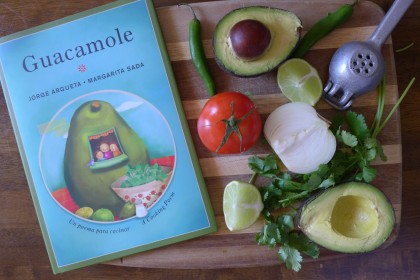
The bottom line is that I suggest a visit to the grocery store before reading "Guacamole". The best way to read this book is like this:

Wednesday, July 23, 2014

DARK EMPEROR & OTHER POEMS OF THE NIGHT, by Joyce Sidman

Quick Facts:
- illustrated by Rick Allen
- poetry
- collection
- Newbery Honor Book

"Dark Emperor & Other Poems of the Night" is a collection of poems linked by the theme of what happens in nature after the sun goes down. The poems are organized in a natural progression, beginning (appropriately) with "Welcome to the Night" and ending with "Moon's Lament", which reflects the moons feelings about the coming dawn.

Despite their strong thematic link, each poem is distinct and self-contained enough to be enjoyed on its own. The effect of this is that the poems complement one another, rather than relying on one another. You can enjoy "Night-Spider's Advice", for example, completely on it's own. But you see it in a different light once you've read "Cricket Speaks", simply for the way in which you can imagine these two perspectives might be at sometimes fatal odds.

One of the most interesting choices author Joyce Sidman makes is to include an informational blurb with each poem, printed on the page opposite the poem. This information actually serves to support and deepen the reader's understanding of the poem, while also providing a teaching moment about nature. For example, on page 8 the poem "Snail at Moonrise" refers to a snail as "shell-maker". The informational blurb on page 9 then elaborates on this, telling the reader that young snails produce a special material that helps them add layers to their shells as they grow. By focusing the informational blurb to what is relevant to the poem, Sidman not only provides support for understanding her poems, but encourages the reader to be active in their reading of her poetry.

"Dark Emperor & Other Poems of the Night" contains many different poetry styles, each poem playing with rhyme, rhythm and sounds in different ways. For example, consider this portion of one of my favorite poems, "Ballad of the Wandering Eft":

"Come all you young efts,
so brave and so bold,
and don the bright colors
of scarlet and gold.

Step out from your puddles
to breathe the sweet air
and wander the woodlands
with hardly a care.

     For it's wild and it's windy
    way out in the woods,
    where the moss grows like candy
    and the hunting is good,
    where the rain falls from heaven
       and mud's underfoot
    It's wild and it's windy
    way out in the woods.
- "Dark Emperor & Other Poems of the Night", page 24

As is typical with ballads, it has a repeating verse (the italicized one), and uses consistent syllable patterns and rhyme to create a rhythmic flow to the poem. The poem is structured symmetrically: verse, verse, chorus, verse, verse, chorus.

Now consider "Dark Emperor". Along with having no rhyming pattern or syllabic consistency, "Dark Emperor" plays with words in a wholly different way:


The poem looks like an owl! The final verse, which references a "tiny hiccup" when considering the owl's predatory prowess looks (in contrast and placement) like a small animal about to become the owl's prey. This diversity in poetic style and structure makes "Dark Emperor & Other Poems of the Night" an excellent introduction for students to the variety of forms poetry assumes.

Finally, Rick Allen's woodcut illustrations are appropriate and support the poems not only by highlighting both the grit and beauty of nature, but by using the play of darkness against light in a way suggestive of the moon glinting through leaves:


These images support the sense that the poems give the reader of glimpsing into a familiar and yet unknown world, the effect of the woodcut style and the play with light rendering familiar images more complex then we are used to seeing them.

Friday, July 18, 2014

GOOD BOOKS, GOOD TIMES!, compiled by Lee Bennett Hopkins

Quick Facts:
- illustrated by Harvey Stevenson
- poetry collection
- 32 pages
- contributing poets include: Karla Kuskin, Jack Prelutsky, Arnold Lobel, and more


Good Books, Good Times! is an anthology of poems collected specifically for their focus on books and reading. There are fourteen poems in all, and each poem is given a full, two-page spread for both the poem and its accompanying illustration. The effect of this is that the reader is truly able to focus on and get lost in each poem, without any distraction from the accompanying page. I love Shel Silverstein's Where the Sidewalk Ends, but I remember as a child rushing through certain poems because the illustration on the opposite page made its poem look so much more interesting. Good Books, Good Times! therefore does an effective job of allowing each poem to really be appreciated on its own.

One thing that impressed me about this anthology was the variety of poetry styles that are represented. Despite having only fourteen poems, the collection includes everything from free verse to familiar rhyming patterns to poems with only two words in each line. This makes it a wonderful introduction to poetry for children who may have the idea that poetry has to rhyme, or is always bound by specific syllable patterns. I love imagining students' faces after having this poem read to them:

AN HISTORIC MOMENT
by William J. Harris

The man said,
after inventing poetry,
"WOW!"
and did a full somersault.
- Good Books, Good Times!

Harvey Stevenson's illustrations to a wonderful job reflecting the poems they accompany in ways that often bring even more humor to the poem, and can help new readers of poetry begin to understand how you read and take meaning from poems. For example, look at the illustration that accompanies "An Historic Moment" from above:


There are many ways this could have been illustrated that would have shown the events of the poem. For example, Stevenson could have chose to divide the story in to separate frames, telling each moment (inventing poetry, WOW!, and the somersault) individually. However, that would not have been a true reflection of the poetry style Harris uses here. The poem is short, abrubt, unexpected. The entire poem, is in effect, a single moment- the moment that the man invented poetry. Thus, Stevenson's choice to show only that moment of movement into a somersault is completely appropriate. Too, it's funnier!

Which raises another point about the poems in this book- they are fun to read. Below is the first verse one of my favorites, by Isabel Joshlin Glaser and titled "What If . . .":

What if . . .
   You opened a book
   About dinosaurs
And one stumbled out
And another and another
   And more and more pour
Until the whole place
Is bumbling and rumbling
And groaning and moaning
   And snoring and roaring
And dinosauring?

Not only does it address a very real, rather wishful thought many of us have about our books (even in our twenties!) but it's fun to read, particularly aloud. "Bumbling and rumbling" and "snoring and roaring and dinosauring" are just silly and fun to say. This is important because the theme of the collection is the joy of reading. If it were full of poems that discussed the joy of reading without bringing any joy to their own reading, the collection would have fallen a bit flat.

Good Books, Good Times! is an excellent introduction to several different types of poetry, and to a variety of poets who whose work is truly fun to read. The illustrations lend humor while also providing support for interpretation of each poem. Overall, it is an excellent read-aloud choice for young readers of all ages, but is a particularly good starting point for independent readers beginning to grasp the concept of rhythm and rhyme.