Sunday, July 20, 2014

THE ONE AND ONLY IVAN, by Katherine Applegate

Quick Facts:
- Newbery Award Winner
- Illustrated by Patricia Castelao Costa
- 305 pages
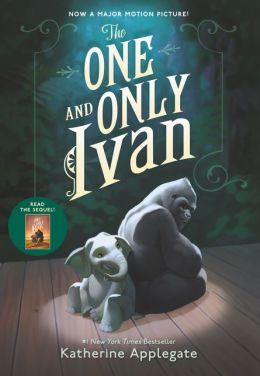

The best thing about The One and Only Ivan is that once you've finished it, once you've cried and cheered and rooted for Ivan for 305 pages, you find out that it's true. You learn that there was actually a silverback named Ivan who lived in solitary captivity in Washington state until public outcry and pressure led to his being sent on "permanent loan" to Zoo Atlanta, where he lived to the age of 50. You learn that he was known for his paintings. You begin to wish that this book had come out just a few years earlier so that after you read it you would still have the chance to visit Ivan. To maybe purchase one of his pictures.

And that's when it starts to hit you. If there really was a silverback named Ivan whose life took the general trajectory of the titular character in Katherine Applegate's novel, then it's not just the good parts that are true, it's all of the hideousness and pain that came before them as well. It's little Ivan being ripped away from his parents. It's Tag dying en route to America. It's a mighty silverback gorilla living, alone, for twenty-seven years without seeing any others of his kind.

And didn't you- in your elation over his existence and your wish that you could visit him- didn't you just represent the very culture that allowed these things to occur?

The power of Applegate's novel lies not simply in how relatable she makes Ivan, but in the questions she forces us to face in ourselves. One way she does this is by making his captor frighteningly relatable. It's easy to read the scene in which Mack goads Ruby with the claw-stick and think, "How terrible, I would never stand around and allow that to happen!" It's less easy to say that about the scenes of Ivan growing up in Mack's house.

"It was Mack who pried open that crate, Mack who bought me, and Mack who raised me like a human baby."
- The One and Only Ivan, page 130

Ivan wears diapers, drinks from a bottle, sleeps in human beds, and is even taken to dinner with Mack and his wife. He is not abused or left in a cage alone, and really, the image of a baby gorilla in a diaper is so adorable- can it really be such a bad thing? Would we really react to it as animal cruelty if we saw it on the street? The hard answer is that unfortunately, most of us would not.

Despite the how relatable these scenes are, Applegate never for a moment lets the reader forget why it is, indeed, pure selfishness and cruelty:

"One day, after many weeks of loud talking, Helen packed a bag and slammed the front door and never came back.

I don't know why. I never know the why of humans.

That night, I slept with Mack in his bed.

My old nests were woven of leaves and sticks and shaped like his bathtub, cool green cocoons.

Mack's bed, like mine, was flat, hot, without sticks or stars."
- The One and Only Ivan, page 141

Though Mack does not physically abuse Ivan, he tries to treat him as though he is human, and in doing so denies the very fact that Ivan is a gorilla. This complete removal of everything that makes Ivan a gorilla is itself abuse. Gorillas are not pets, and there is no in-between about it: keeping a gorilla as a pet is just as wrong as turning a gorilla into a roadside attraction.

Here, Bob the mutt serves as an interesting contrast to Ivan's situation. Unlike Ivan, who was born and (initially) raised a wild animal before falling into human captivity, Applegate implies that Bob was the product of a different type of human cruelty altogether: overbreeding and indifference.

"Bob used to have three brothers and two sisters. Humans tossed them out of a truck and onto the freeway when they were a few weeks old. Bob rolled into a ditch.

The others did not."
- The One and Only Ivan, page 35

Bob, the product of dogs bred as house dogs even if he himself is not one, can barely scrape by on his own, in this human world into which he was tossed to die. He is not a wild animal, he is a natural and deliberately bred human companion. Thus, the fact that he ends the novel living with Julia is more than just a happy ending, it's where he should be, where (like Ivan at Zoo Atlanta) he is most likely to thrive.

And yet, still, there is something unsatisfying in both of their stories. Because really, we don't want Ivan at Zoo Atlanta, we want him to have never been ripped from his family in the Democratic Republic of the Congo. We don't want Bob to have come to Julia the way he did; we wish that he and all of his brothers and sisters could be living with her. But are either of those things even possible in today's world? Or are zoos and loving people who show up after the fact the best we can hope for?

It is these complicated and emotional questions that make The One and Only Ivan such a powerful story, particularly for children. Because, of course, the answer is that if human attitude towards and treatment of animals is going to change, it has to begin with the children.

Below is a video of the real Ivan, released by Zoo Atlanta after his passing in 2012:


Friday, July 18, 2014

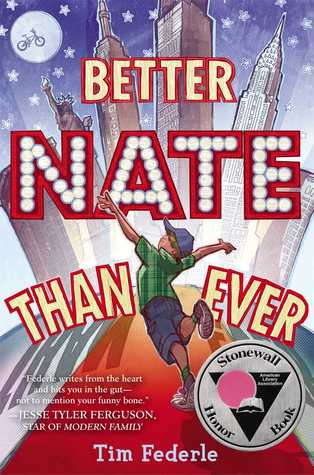
BETTER NATE THAN EVER, by Tim Federle

Quick Facts:
- 304 pages
- 2014 Odyssey Honor Book
- 2014 Lambda Literary Award Nominee for LGBT Children's/Young Adult
- this review is based on the audiobook
   + read by author Tim Federle
   + 5 hr, 55 min


There are books you read, both as a child and as an adult, that you enjoy because the characters inspire you in all the ways that they are different from you. They are braver and wittier and stronger, and you take from them lessons about how you can be all those things.

And then there are books you love because the characters are so like you, so awkwardly and painfully and hilariously real, that there are times it's as if the author jumped inside your head and used your thoughts.

In Nate Foster, the droll hero of Better Nate than Ever, author Tim Federle has created a character with whom it's nearly impossible not to empathize. The book chronicles Nate's attempt to crash an open audition in New York for a new Broadway show: E.T.: The Musical. The obstacles Nate encounters along the way, and his reactions to them, are just so perfectly authentic and treated with such humor, that you find yourself rooting for Nate even when you know something isn't going to go as he plans.

Which is not to say that Better Nate than Ever is a pure exercise in comedy. In a video for the New York Times "Culture" section, Federle discusses his awareness of the "gatekeepers" in children's literature. His goal when writing, he says, is to write something authentic that will entertain the adults as much as the children (he refers to it, appropriately, as the "Pixar Model".) Two major influences on his comedic style have been Ellen Degeneres and Bill Cosby, specifically for the way in which they addressed real topics with humor and without resorting to the "low hanging fruit" of "being mean or swearing."

I mention all of this because Better Nate than Ever deals with some very real issues. Nate is an exceptional child, and that makes him a flashing target for people's crueler impulses- even those of his own family. There are some really painful scenes, particularly involving Nate's brother and the way that Nate is treated in school. Federle never allows these scenes to become too heavy, primarily through Nate's humor about them, but it is clear nonetheless that the very humor that gets Nate through it is also a coping mechanism for survival.

Better Nate than Ever was nominated for the Lambda Literary Award, which recognizes books addressing the LGBT experience. However, it is not at all an LGBT issues book. Federle makes the wise and effective choice to place Nate as an individual at the center of his novel, so that everything else is secondary to Nate's own unique experience. Regarding his sexuality, Nate says only:

"My sexuality, by the way, is off-topic and unrelated. I am undecided. I am a freshman at the College of Sexuality and I have undecided my major, and frankly don't want to declare anything other than "Hey, jerks, I'm thirteen, leave me alone. Macaroni and cheese is still my favorite food- how would I know who I want to hook up with?"
- Better Nate than Ever

This refusal to label his thirteen-year old protagonist allows Federle to truly explore all the uncertainty, self-questioning, and confusion that comes with puberty in a way that is accessible for all young adults. Will young boys like Nate relate more closely to the character? Of course. But Nate's determination not to fit in to any box or allow himself to be labeled sends a much needed message to these kids (and to all kids): it's ok to be confused. It's ok to be unsure of yourself. You're still a kid, and you don't have to decide or announce anything to anyone.

The audiobook for Better Nate than Ever was a 2014 Odyssey Honor book, and I strongly recommend listening to it, even if you have already read the print version. Federle's reading of his novel brings Nate to life in all of his awkwardly hilarious glory and when it was over I felt strangely bereft of a friend.

Fortunately for me and for the world, Federle has already written a sequel to Better Nate than Ever: Five, Six, Seven, Nate!. I've already downloaded the audiobook to my phone.

GOOD BOOKS, GOOD TIMES!, compiled by Lee Bennett Hopkins

Quick Facts:
- illustrated by Harvey Stevenson
- poetry collection
- 32 pages
- contributing poets include: Karla Kuskin, Jack Prelutsky, Arnold Lobel, and more


Good Books, Good Times! is an anthology of poems collected specifically for their focus on books and reading. There are fourteen poems in all, and each poem is given a full, two-page spread for both the poem and its accompanying illustration. The effect of this is that the reader is truly able to focus on and get lost in each poem, without any distraction from the accompanying page. I love Shel Silverstein's Where the Sidewalk Ends, but I remember as a child rushing through certain poems because the illustration on the opposite page made its poem look so much more interesting. Good Books, Good Times! therefore does an effective job of allowing each poem to really be appreciated on its own.

One thing that impressed me about this anthology was the variety of poetry styles that are represented. Despite having only fourteen poems, the collection includes everything from free verse to familiar rhyming patterns to poems with only two words in each line. This makes it a wonderful introduction to poetry for children who may have the idea that poetry has to rhyme, or is always bound by specific syllable patterns. I love imagining students' faces after having this poem read to them:

AN HISTORIC MOMENT
by William J. Harris

The man said,
after inventing poetry,
"WOW!"
and did a full somersault.
- Good Books, Good Times!

Harvey Stevenson's illustrations to a wonderful job reflecting the poems they accompany in ways that often bring even more humor to the poem, and can help new readers of poetry begin to understand how you read and take meaning from poems. For example, look at the illustration that accompanies "An Historic Moment" from above:


There are many ways this could have been illustrated that would have shown the events of the poem. For example, Stevenson could have chose to divide the story in to separate frames, telling each moment (inventing poetry, WOW!, and the somersault) individually. However, that would not have been a true reflection of the poetry style Harris uses here. The poem is short, abrubt, unexpected. The entire poem, is in effect, a single moment- the moment that the man invented poetry. Thus, Stevenson's choice to show only that moment of movement into a somersault is completely appropriate. Too, it's funnier!

Which raises another point about the poems in this book- they are fun to read. Below is the first verse one of my favorites, by Isabel Joshlin Glaser and titled "What If . . .":

What if . . .
   You opened a book
   About dinosaurs
And one stumbled out
And another and another
   And more and more pour
Until the whole place
Is bumbling and rumbling
And groaning and moaning
   And snoring and roaring
And dinosauring?

Not only does it address a very real, rather wishful thought many of us have about our books (even in our twenties!) but it's fun to read, particularly aloud. "Bumbling and rumbling" and "snoring and roaring and dinosauring" are just silly and fun to say. This is important because the theme of the collection is the joy of reading. If it were full of poems that discussed the joy of reading without bringing any joy to their own reading, the collection would have fallen a bit flat.

Good Books, Good Times! is an excellent introduction to several different types of poetry, and to a variety of poets who whose work is truly fun to read. The illustrations lend humor while also providing support for interpretation of each poem. Overall, it is an excellent read-aloud choice for young readers of all ages, but is a particularly good starting point for independent readers beginning to grasp the concept of rhythm and rhyme.

Thursday, July 17, 2014

NELSON MANDELA, by Kadir Nelson

Quick Facts:
- 40 pages
- Written and illustrated by Kadir Nelson
- Coretta Scott King Honor Book


Considering the incredible position he holds as a symbol of hope and freedom from oppression in South Africa, and the profound respect with which he is viewed worldwide, it is surprising to me that Nelson Mandela is not often included in elementary curriculums. Mandela is certainly more immediately relevant to world politics than many of the figures students regularly study. That is not to say that these figures should be removed, but rather that Mandela's influence on world politics makes him as worthy of our students' attention as other great leaders of peace, like Martin Luther King, Jr. and Mahatma Gandhi.

I was very, very excited, therefore, to discover Nelson Mandela, an illustrated, biographical account of Mandela's life, written and illustrated by the award-winning Kadir Nelson.

[NOTE: Confusingly, "Nelson" is the name of both the subject and the author. Thus, Nelson Mandela will consistently be referred to by either his full name or his last name "Mandela", while author Kadir Nelson will be referenced as "Nelson".]

Nelson Mandela is arranged as a chronological series of vignettes in Mandela's life, incorporating both iconic images like the one shown above (which is also the cover of the book) as well as the author's imagining the landmarks in Mandela's life. In both instances, Nelson uses lyrical free verse and richly-colored illustrations to tell the story of how a young Madiba boy named Rolihlahla became Nelson Mandela. Take, for example, the pages shown below:


The text reads:

"Nelson was nine when his father
joined the ancestors in the sky.
To continue his schooling,
Nelson was sent miles away
to live with a powerful chief.
"Brace yourself, my boy."
His mother held her tears
and said good-bye."
- Nelson Mandela, pages 3-4

The text is tells of a painful time of change for Mandela, a time during which he lost his father and was sent away from his mother. It is appropriate, then, that the color red dominates both Mandela and his mother. Red is the color of pain, of suffering, and that reflects Mandela's life at this point. The horizon, however, fades from shades for red into shades of blue, and I believe this a deliberate choice when once considers where Mandela is going. He is leaving to continue his schooling, the beginning of a journey that will lead him to become a great global symbol of peace. Blue is the color of peace and tranquility; by placing it behind Mandela and his mother, Nelson hints that despite their present pain, their separation will ultimately lead to peace.

Perhaps one of the most appropriate choices in Nelson Mandela was to have every illustration a full-bleed, two-page spread. Kadir Nelson's biography is telling the dramatic, legendary rise of a man who not only fought for equality in one of the most divided nations in recent history, but who then successfully, and peacefully!, led that nation it its unification. This story of Nelson Mandela is larger than life, and turning page after page of rich, two-page illustrations reinforces that.


Both an author's note and a bibliography are included at the end of Nelson Mandela, as reference for its biographical claims. As a companion to the book, a DVD was recently released with Forest Whitaker reading the book and an interview with author Kadir Nelson at the end. I haven't had a chance to check it out yet, but it comes highly recommended by School Library Journal.

I visited South Africa this past May, and the respect and genuine love with which every South African I met spoke of Nelson Mandela (regardless of their skin color) affected me profoundly. He is truly one of the most incredible historical figures of the past fifty years, and this book is a beautiful tribute to his life and work.

THE BEST BOOK OF BUGS, by Claire Llewellyn

Quick Facts:
- 32 pages
- nonfiction

The Best Book of Bugs is a bold title for author (and illustrator?*) Claire Llewellyn to have chosen, especially since there are an abundance of picture books about bugs for children. However, while I lack the bug-book background for wide comparison, I can confirm that this is a truly excellent book about bugs, describing the habits, habitats and life cycles of a variety of insects.

Information about bugs aside, perhaps one of the best things that The Best Book of Bugs does is help develop a young reader's pragmatic awareness of how traditional informational texts are arranged. The book begins with a table of contents where the reader can determine the location of each topic discussed in the book. This table of contents includes illustrations to accompany the text, so that even emerging readers can determine (for example) that bees are discussed on pages 12 and 14:


The pages are numbered along their bottom outside corner, and each section is labeled (in font larger and bolder than that found on the rest of the page) identically to the way it was named in the table of contents. Pages 32-33 at the very end of the book contain a glossary of terms used throughout the book. That said, glossary terms are not bolded throughout the book, which means that in terms of full functionality as an information text, The Best Book of Bugs is better suited to readers with a bit of familiarity already with how a glossary works.

In terms of the information and page-layout, The Best Book of Bugs does not waste any space, while still maintaining readability and flow. Consider the following page:


There is a lot going on here, but it is carefully organized. Each bug shown is clearly labeled, with lines connecting label information to specific parts of the bug. For the two illustrations which have a more substantial amount of text accompanying them (the central, cross-page stream and the Damselfly Nymph), a small triangular bullet precedes the text, pointing in the direction of its accompanying illustration. Bookending the central information are panels showing information on two clearly labeled topics. Along the far left edge, moving down the page, are outlined the steps a dragonfly nymph follows to catch a meal. Along the far right edge, moving down the page, are three examples of how different water bugs obtain oxygen. This structure allows a great deal of information to be shared in a way that is simple for the reader to navigate and digest.

The illustrations accompanying the text in this book are wholly realistic, which is appropriate both for an informational text and also for the detail with which the text at times discusses its subject matter. Take, for example, the following section on the "stag beetle":


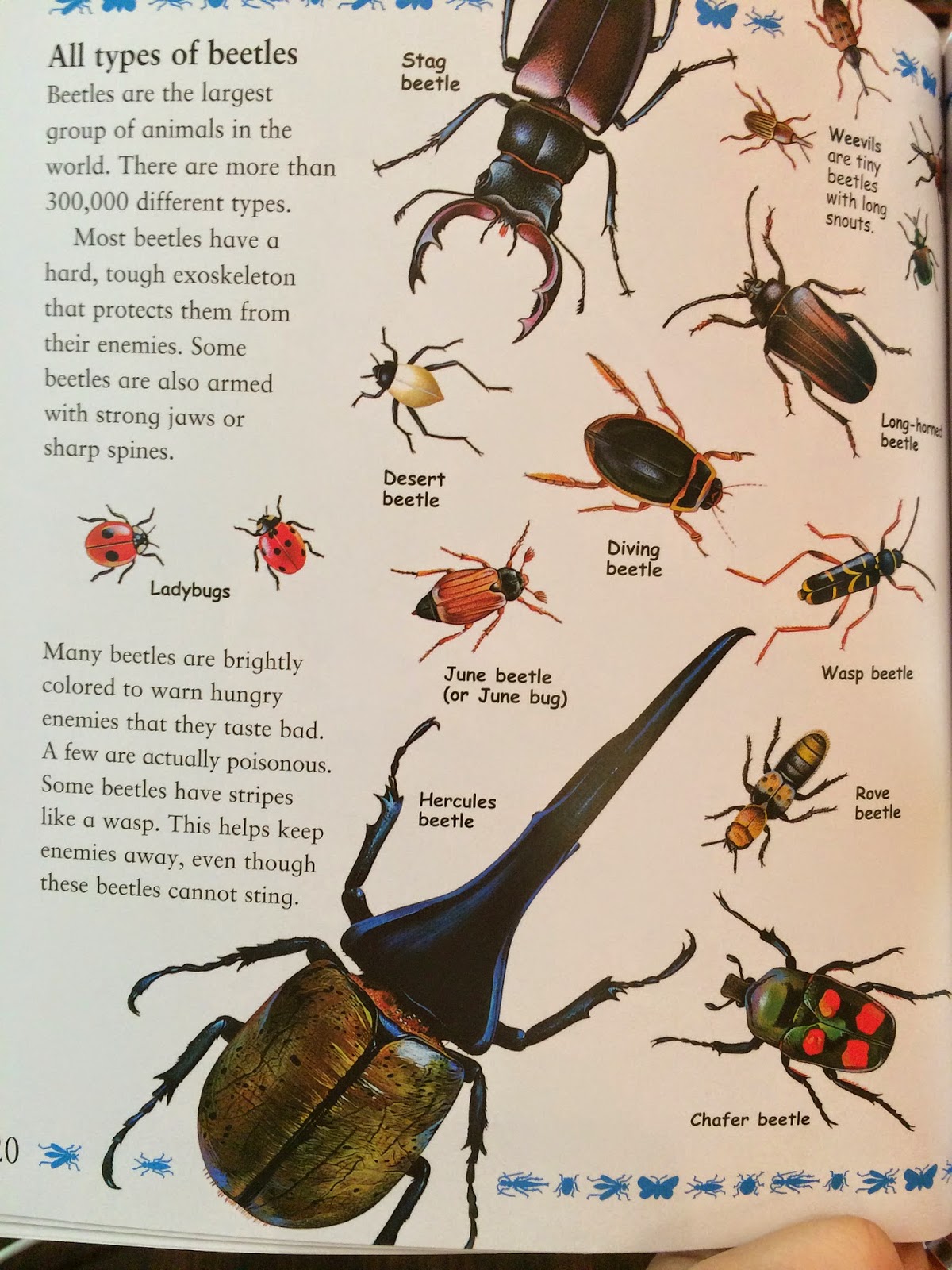
A more impressionistic illustration, focusing primarily on shape and color (like those in Planting a Rainbow) would not permit the reader to see the way in which the stag beetle's jaws look like "horns or antlers." What's more, it would provide little basis of comparison for the reader to distinguish the differences between the different types of beetles shown later:


Overall, The Best Book of Bugs is a very informative, easily navigated book about bugs for young readers. Because of the size of it's type (average is about size 12 font), the scientific language used ("nymph", "oxygen", etc.), and the lack of bolded glossary words, I would recommend it for ages 8+. 

Also, for readers interested in bugs. You have to really like bugs.

*This seems implied by the bibliographic information, but is not explicitly stated. 

PLANTING A RAINBOW, by Lois Ehlert

Quick Facts:
- picturebook
- 40 pages
- Written and Illustrated by Lois Ehlert

This book is an excellent introduction for young children to the process and steps involved in growing a garden, as well as to a variety of colorful plant species. The story is simple, and established in the very first line:

"Every year Mom and I plant a rainbow"
- Planting a Rainbow, page 1

Note that the colors used in the text for "rainbow" are the colors of the rainbow, in backwards order than children will later learn them in school (ROY G BIV, anyone?) This simple and yet careful attention to detail is characteristic of the book as a whole.

Both the language and illustrations Ehlert uses are developmentally appropriate for beginning readers and young children (not always the same thing!) Though she uses vocabulary specific to her topic of gardening (e.g. bulb, seedlings, sprout, soil), her sentence structure remains very basic:

"In the fall we buy some bulbs and plant them in the ground."
- Planting a Rainbow, page 2-3

You'll notice that in both quotes I've used, I've made the text larger. This is to reflect Ehlert's use of large, easy-to-read font, which not only lends itself to the aesthetic of the book, but makes it easier for little hands to point as they read.

Her accompanying illustrations reflect the accurate and yet easy-to-read nature of her prose. Rather than including incredibly detailed pictures of the plants she describes, Ehlert elects to show instead the general impression the flower (or bulb) makes, focusing on shape and color as her means of communicating this. For example, observe the five different bulbs and flowers shown in the illustration below:


Each bulb and flower is unique, reflecting through shape and color the overall effect of the flower. Furthermore, each labeled species is accurately depicted, distinct from the ones surrounding it. Compare, for example, the below images of a daffodil and its bulbs to the center illustration of a daffodil above.

Daffodil (Narcissus)
Daffodil (Narcissus) Bulbs

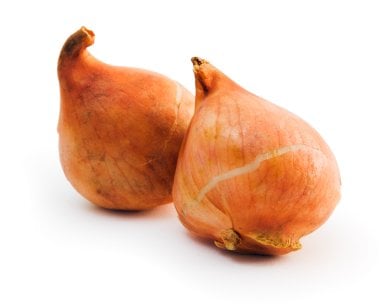
Ehlert has depicted daffodils accurately in shape and color, down to the darker yellow/orange center and the bulbs that are larger, and grayish in contrast to the red/orange of a tulip bulb and the purple of a hyacinth bulb (see the below image of tulip and hyacinth bulbs for proof of this contrast).
Tulip Bulbs

Hyacinth Bulbs
Childrens' ability to perceive the details that distinguish objects develops as they grow older. A very young child, for example, might perceive only that these are all flowers because they have basic characteristics the child associates with flowers: growing out of the ground, a stem, a colorful head. Thus, Ehlert's focus on the overall effect of the flower, rather than on more realistic detail, is appropriate for very young readers who are still develop their ability to classify objects. Though they are both flowers, Ehlert's illustrations make it easy to tell (for example) that the daffodil is differs from the tulip in color and shape, both of which are characteristics children can use for object classification early in their development.

On the topic of color, Ehlert ends her book with a call back to the rainbow of the very first page. Once the flowers have all bloomed, she takes her readers through each of the species, organized by color, and in order of the light spectrum:


Each color marks the edge of a page, which is identical to the one showing in structure. The flowers shown on each page reflect the color shown on the right side of the page. This not only aids children in developing their color classification, but subtly reinforces the spectrum colors, and the order in which they appear.

Planting a Rainbow is a beautiful and informational book for readers of all ages, but it is designed to be particularly appropriate for the development of very young children and readers.

THE BIRD ALPHABET BOOK, by Jerry Pallotta and Edgar Stewart

Quick Facts:
- Illustrated by Edgar Stewart
- alphabet picture book
- 32 pages


The Bird Alphabet Book, written by Jerry Pallotta and illustrated by Edgar Stewart, is a beautifully illustrated alphabet book that introduces the reader to twenty-six different species of bird (plus one bonus mammal!) The book does a lovely job of presenting specific information about each of the species that is likely to engage young readers, and which anticipates their questions about each bird.

Consider, for example, the following page for "T":


As an informational book, Pallotta is bound to provide factual information on the birds he chooses to represent each letter. However, it is clear that he put a good deal of thought not only into which birds would be the most visually interesting for young readers, but which ones were likely to inspire childrens' questions. By choosing a toucan to represent the letter "T", Pallotta not only selected a bird that is unique and interesting to the eye, but that looks a little goofy. You can imagine a child giggling and pointing to the long orange beak, asking, "But why the beak so long?"

This is where the collaboration between author and illustrator becomes clear. Rather than explain that the toucan's beak helps it reach food deep inside tree holes, Pallotta allows this information to be shown by Stewart's illustration. This leaves Pallotta free to address the next likely question: but isn't the beak heavy? One of the frustrating aspects of informational books for both parents and children can be when the book doesn't have information to answer the questions children have. Though The Bird Alphabet Book certainly doesn't answer all questions, it does endeavor to anticipate and respond to as many of them as possible.

Perhaps one of the best moments of anticipating the readers' questions occurs at the very beginning of the book, with the letter "B":

The text here reads:

"B is for Bat. Hey, wait a second! Bats are not birds. Bats are mammals Even though they have wings and they can fly, they do not have feathers. Get out of this book, you Bats!

Now that the Bats are gone, let's find a bird whose name begins with the letter B."
-The Bird Alphabet Book, page 2-3

Bats, by virtue of the place they hold in popular culture as a symbol of the night (and also the way their name rhymes with "cat" and "mat" and "sat"!), are some of the first animals with which children often become aware- even if they've never seen one in real life! The bird that Pallotta chooses for "B" is the blue-footed booby. Without the page shown above, it is easy to imagine a child turning to their parent and asking, "But what about bats? Bats start with B. Why no bats?" And quite frankly, most parents would probably have to Wikipedia to determine why a bat would not be included in a bird alphabet book for children (I would have!)

Thus, Pallotta addresses the question head on, using a full, two-page spread to do so. By not placing the bat on a single page next to a bird, Pallotta sets bats apart from the birds he discusses. Each of the birds gets only one page, and so this section about the bat actually interrupts the flow of the book. All of this contributes to the main point Pallotta is making about bats: that they are NOT BIRDS. 

Like Pallotta, Stewart had an obligation to depict each species as accurately as possible, and his gorgeous watercolors are successful in this. However, frequently uses the animals' eyes to show expression and personality that make the illustrations more engaging than they might be otherwise. Look particularly at the eyes of the crocodile below (included on the page for Crocodile Bird):


He looks like he's laughing! Another excellent example is the White-faced Scops Owl page, in which the owls' eyes make them look very stern:


These images remain accurate to the animals' actual appearance, but lend life to the watercolors.

Perhaps my only reservation about this book is that there is very little that is lyrical or funny about the prose (much less both). Which is not to say that all books for children must be written lyrically or be crammed full of laughs! However, I think that an alphabet book is an obvious place to use lyrical language, particularly since children learn their alphabet in the form of a song. In terms of the humor, it is present in a few places (like the "Bat" page) but is not consistent in its usage. This, at times, made the writing feel a bit too dry for me, despite the wonderful job Pallotta did in selecting the information he presented for each species. I think that this, as well as the overall flow of the book, could have been improved had either the language bit more lyrical or the humor more consistently employed.

Overall, this a book best suited for readers 2nd-3rd grade and older. Though younger readers will enjoy having it read too them, some of the species choices (such as "Indigo Bunting", "Blue-footed Booby) and "White-faced Scops Owl") are simply not appropriate linguistic challenges for beginning readers.